A Landscape with Two Dead Trees

- Artist: Jan Wijnants
- Date: probably 1665-75
- Medium: oil on wood
- Museum: The National Gallery
- Collection record: The National Gallery website
Listen to the free audio guide
About this artwork
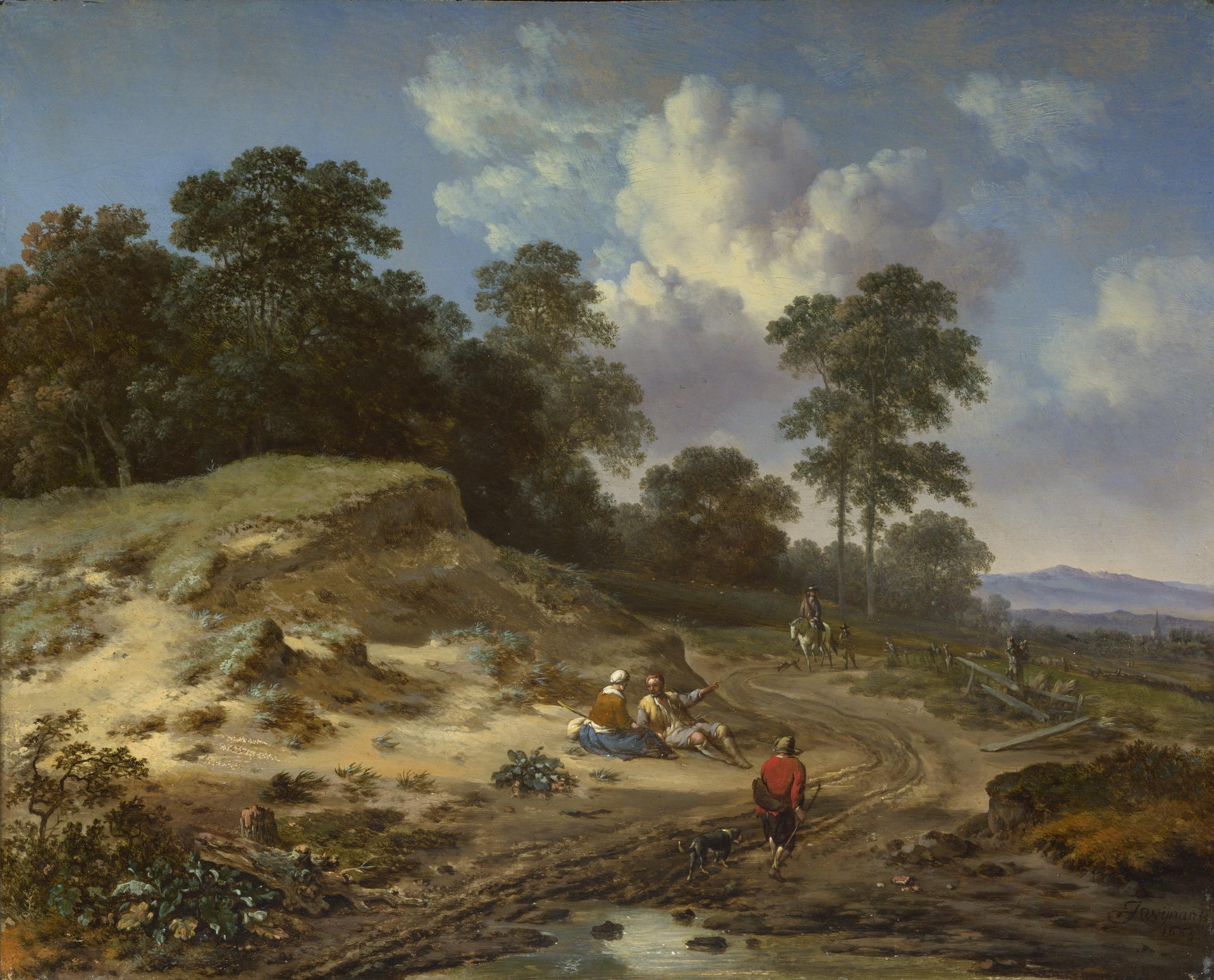
This is "A Landscape with Two Dead Trees" by Jan Wijnants. Painted in the Dutch Golden Age, it's a beautiful example of how landscape art was used to create an idyllic country view. The strong sweeping curve of the track dominates the middle of the picture, where we see two greyhounds racing each other while a horseman and his companion chat easily as they go.
In the distance, we glimpse what seems to be a pedlar with his pack ambling along behind them. The woodland to the right is in full summer leaf, billowing upwards like the cumulus clouds that bloom in the luminous sky. It's a pleasing view, with a cluster of houses, the outline of a church, and an orchard all visible in the distance.
But what really draws your attention are the two dead trees at the front of the picture. The nearer one is thrust towards us, its limbs fallen, with moss and lichen spreading over the remaining bark. It's a visual device that helps create a sense of depth to the landscape, but it also adds a note of melancholy to this otherwise idyllic scene.
This painting likely dates back to the mid-17th century, around 1665-75, and is made from oil on wood. Wijnants frequently used dead or dying trees in his landscapes as a way to add a reminder of mortality to these peaceful country views.
See it in person
A Landscape with Two Dead Trees hangs in The National Gallery on Trafalgar Square, London — free to enter. Point your phone at any artwork there and audioguide.london plays a free audio guide in six languages — no app download needed.